
Mechanical Testing
Keighley Laboratories provides a trusted range of mechanical testing methods for many industries. All tests can be carried out to European, international and customer specific standards for both commercial and aerospace products.The Process
Keighley Laboratories provides a range of processes for mechanical testing services.
The range of processes practised at Keighley Laboratories include:
Tensile and Compression Load Testing
A test piece or component is subjected to tension (or compression) until either a proof load is achieved or failure occurs.
Once failure of the sample occurs, the load-displacement behaviour is examined, determining a stress-strain curve. This will then give mechanical properties that can be measured.
Testing can be carried out on metallic and some non-metallic materials. To national and international specifications as well as bespoke testing designed and carried out to our detailed documented in house procedures. Using our UKAS ISO 17025 flexible scope of approval, our engineers and metallurgists can design and carry out the test which meets your exact requirements whilst still certifying under our UKAS schedule of approval.
Impact Testing
Used to measure the relative toughness or brittleness of a material. It is also used to test its capacity to resist mechanical shock in the presence of a notch at a range of temperatures from ambient to –196°C.
The two main types of testing are CHARPY and IZOD testing.
Hardness Testing
The hardness of a material is its resistance to indentation when a force is applied by a hardened steel/tungsten carbide ball or diamond indentor (conical or square based).
Test methods include Rockwell HR, Vickers HV and Brinell HB.
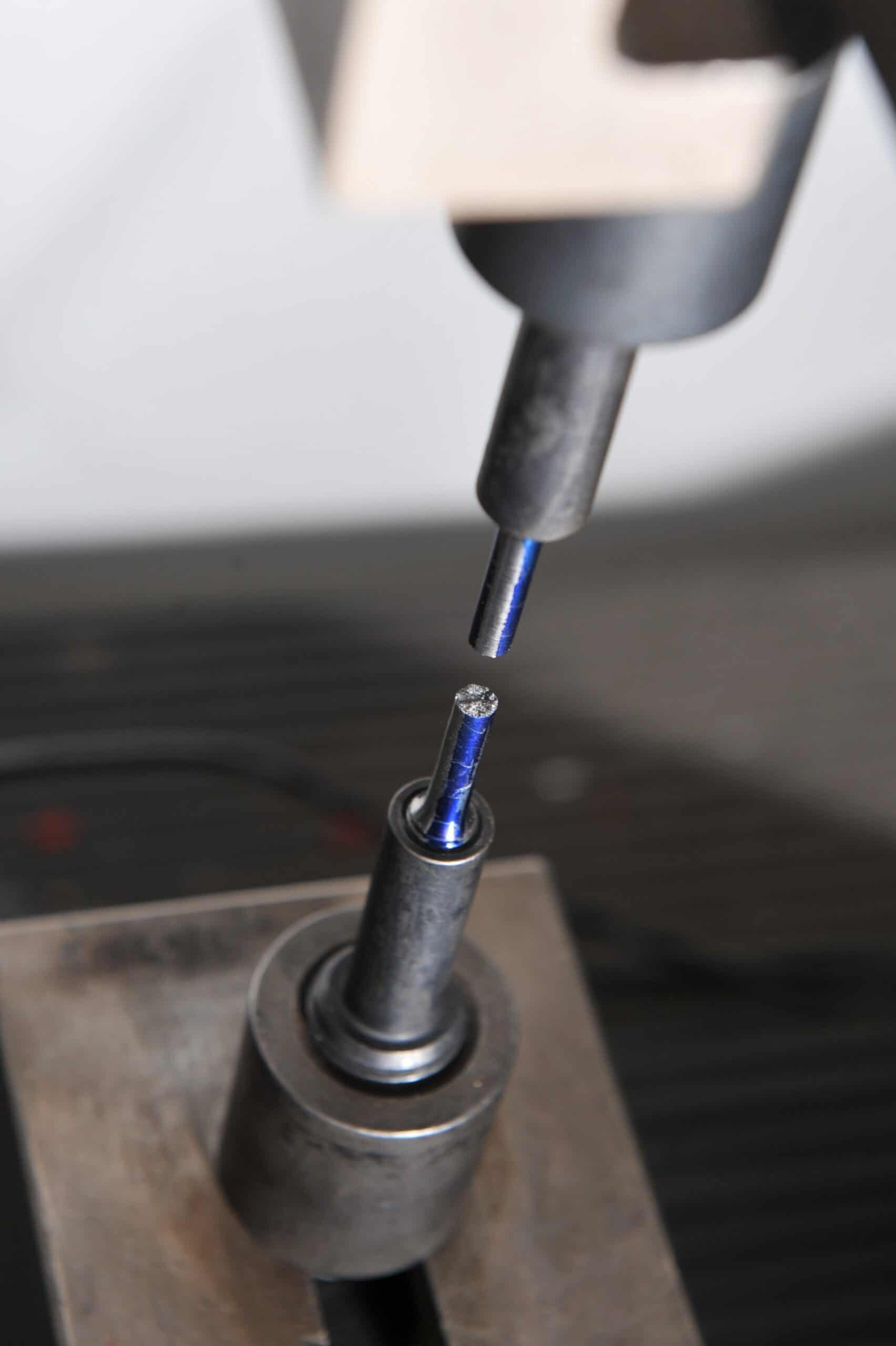
Benefits of Mechanical Testing
Processes can be used to evaluate new or existing products for quality, viability and safety, against a customer or industry specifications. They can also be used to cross-check against supplier certificates or verification that the material is suitable and appropriate for the intended design application, providing assurances on safety and performance.
Processes can determine the peak stress, yield strength, elongation, reduction of area, ductility under stress, Young’s modulus and toughness. Quality control ensures components will survive and perform in intended applications, or as a requirement to a material specification.
Tensile/Load Testing can be carried out on full-size components from small products to bridge retaining bolts. Test pieces are machined in accordance with national and international specifications in our own machine shop.
Customer/inspection authority witness where required.
Our testing machines and in-depth knowledge of products and processes can help you develop new equipment (e.g. extensometers), heat treatment processes as well as product design verification.
Technical Specifications
All of our tests are carried out to European, international and customer standards for both commercial and aerospace products. Additional technical information for our processes include:
The techniques that we use include:
In Tensile Testing, stress-strain and load-deflection curves are produced for different materials for loads from 1kN to 1100kN. Typical specifications include ASTM E8, ASTM A370, BS EN ISO 6892-1, BS EN 2002-1, and compressive yield in accordance with ASTM E9.
Izod testing is generally carried out at room temperature. Typical specification BS131 Part 1.
Charpy Testing can be carried out at temperatures between –196°C and ambient Typical specifications include ASTM E23, ASTM A370, BS EN ISO 148-1.
Hardness Testing can be carried out using Brinell (in house and on-site), Rockwell Standard and Superficial (most scales), Vickers (both micro and macro – manual or semi-automatic). ASTM E10, ASTM E18, ASTM E92, ASTM E384, ASTM A370, ASTM E110, BS EN ISO 6506, BS EN ISO 6507 and BS EN ISO 6508. Portable equipment can also be used on request, such as Equotip®(Leeb) hardness testers, and portable Rockwell and King Brinell machines.
Matthew Mellor
Technical Services Director
Contact Us
Telephone No.+44 (0)1535 664211